Narrative Crossroads: Method Overview
What Is Narrative Crossroads?
Narrative Crossroads is a solo journaling game, played by everyone at once, for character analysis. It helps students analyze literary characters or historical figures by stepping into their shoes at critical decision points—threshold moments where characters face meaningful choices—and writing from inside them.
The framework combines elements from several sources:
- The character-framing structure from my original “Character Analysis Role-Playing” lesson
- The solo journaling tradition, where a prompt and a page do the work of a table
- The atmospheric qualities of indie TTRPGs like The Last Tea Shop
The Solo System
1. Character Selection
Students select a character from the text, or roll a die for one. Each character comes with textual evidence rather than statistics — what they want, and what they fear.
2. Threshold Moment Exploration
Students explore characters at threshold moments—critical turning points in the text, chosen because the character could genuinely have gone either way.
3. Take a Lens
Each student reads the moment through one of three lenses. They pick, or roll a die to spread the room across all three:
| Lens | Read the moment as… |
|---|---|
| Confrontation | A clash. What are you up against, and what does facing it cost? |
| Comprehension | A realization. What do you understand now that you didn’t a moment ago? |
| Connection | The bonds. Who is this really about, and what do you owe them? |
The die only seeds. Nothing is rolled against a character, and there is nothing to succeed or fail at.
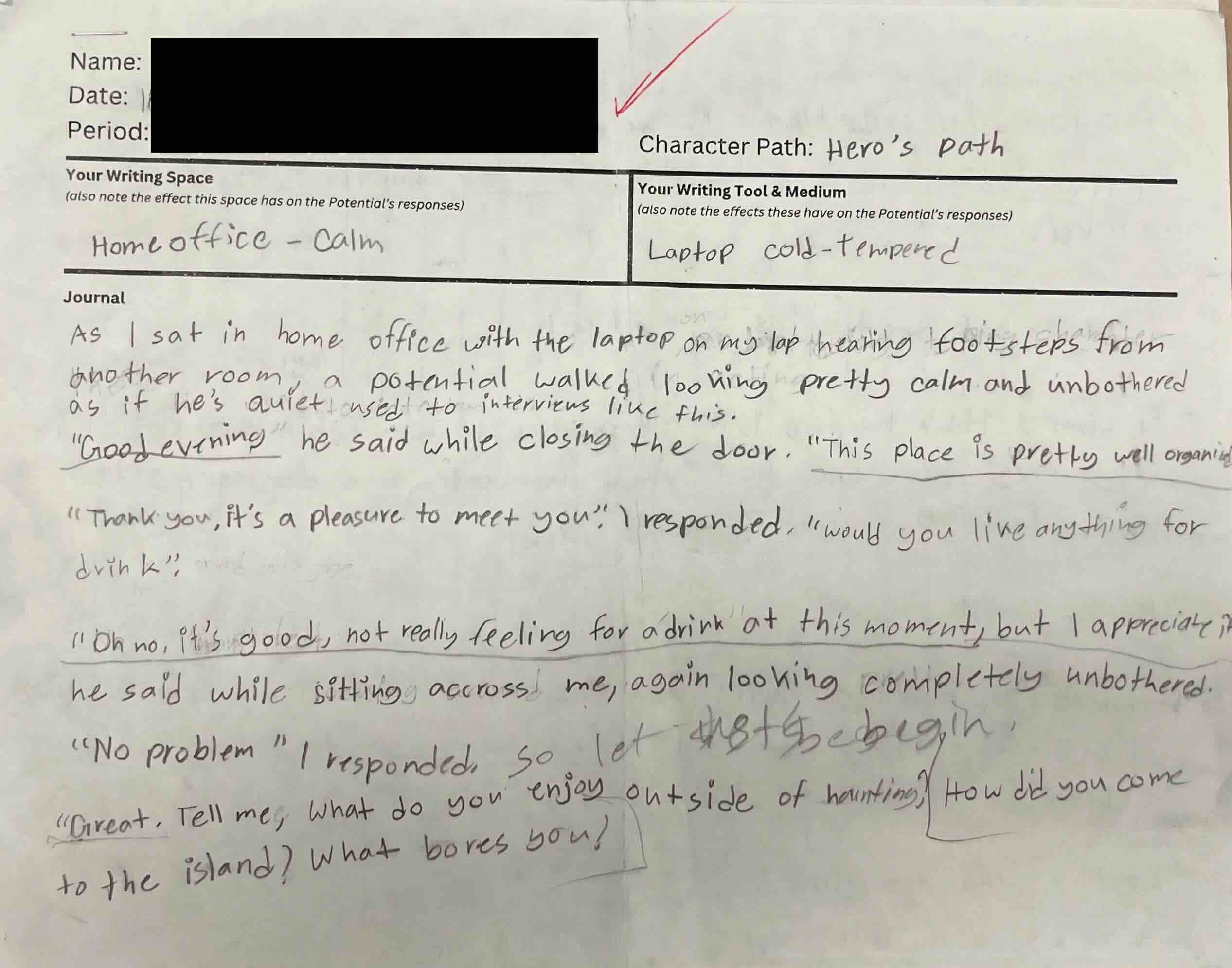
4. Write in Character
Students write a few sentences in the character’s voice, at that moment. The writing is the play.
5. Harvest & Analysis
- Several readings are read aloud, at least one from each lens
- The class asks: which reading does the text support, and what’s your evidence?
- Students connect their readings to character development and textual themes
Implementation Examples
Literary Analysis
The framework helps students understand character motivations in complex texts:
- Exploring Rainsford’s moral dilemma in “The Most Dangerous Game”
- Analyzing the Outsider’s search for identity in Lovecraft’s story
- Understanding the feud’s psychological impact in “The Interlopers”
- Navigating the tragic choices in Romeo and Juliet
Historical Analysis
Narrative Crossroads can be adapted to explore historical figures at pivotal moments:
- A Civil Rights activist deciding whether to participate in a sit-in
- A historical leader making a crucial wartime decision
- An immigrant arriving at Ellis Island in the early 20th century
Classroom Integration
Narrative Crossroads supports several pedagogical goals:
| Goal | How NC Supports It |
|---|---|
| Engagement | Game mechanics provide structure and unpredictability |
| Critical Thinking | Students analyze character motivations and decisions |
| Empathy | Roleplaying develops understanding of diverse perspectives |
| Writing Skills | Journal format strengthens descriptive and reflective writing |
| ML Support | Structured framework scaffolds analysis for multilingual learners |
Assessment Approaches
Narrative Crossroads supports multiple assessment methods:
- Written character journals
- Audio/video readings in character
- Comparative analysis essays
- Collaborative scene creation
- Alternative ending development
The framework aligns with ELA standards including character analysis, evidence-based reasoning, and analytical writing while providing differentiated support for multilingual learners.
Downloads
Ready-to-use modules with character profiles, threshold moments, lens prompts, and implementation guidelines:
- Narrative Crossroads Solo Framework SRD — the System Reference Document: the reusable core of the system (PDF)
- The Most Dangerous Game
- The Interlopers
- The Outsider
- Romeo and Juliet
- Historical Framework Template
Acknowledgments
Narrative Crossroads was inspired in part by Spring Villager’s Last Tea Shop Complete. The game format of Last Tea Shop Complete is open for hacking and remixing under a CC-BY 4.0 license.